Kevin’s soccer ball
Kevin the Star StrikerKevin’s soccer ball is more than sporting equipment: it is the object that keeps the Wild Soccer Bunch connected to soccer when winter, parental punishment, poverty, and Mickey the Bulldozer’s opposition threaten to shut the game down. Scratched and scuffed yet repeatedly reclaimed, hidden, confiscated, traded, and finally returned, the ball gives concrete form to Kevin’s fierce need to play while exposing the limits of his early ball-hogging instinct. By the decisive match, it has become the shared instrument through which the team learns to trust one another and wins together.
Appearance and Place in the Team
Kevin’s soccer ball is introduced as scratched and scuffed, resting on his lap while he and Tyler stare through ice crystals at the gray sky above Wilson Street. Seven inches of snow and ice cover the soccer field, and four days remain before spring break, so the ball becomes the center of an improvised indoor world. Kevin and Tyler throw it back and forth as supposed goalie training, then kick it against the wall in alternating blasts. Danny does the same at 44 Dearborn Street, while Julian and Josh practice across the street and Alex Alexander turns a narrow space between a mirror and a china cabinet into a goal. The ball thus links separate houses and teammates before they can gather on the frozen field.
The object also carries Kevin’s self-image. Kevin calls himself the master dribbler, the Star Striker, and the quickest assist, although Larry recognizes that he can also be a ball-hog, selfish, and stubborn. Because the ball is his possession, it becomes the most immediate expression of that contradiction: it enables his skill, but it also tempts him to treat soccer as an extension of himself rather than a shared game. Larry’s coaching eventually redirects that possessiveness toward passing and collective responsibility.
Conflict with the Family
The ball becomes a flashpoint when indoor play damages a lamp. The parents punish Tyler and Kevin, let the air out of their ball, hide the pump, and condemn the brothers to pay for the lamp from their piggy bank. When Kevin’s father comes to take the ball away, Kevin claims it as his own, pushes past him, and reaches the bedroom first. He then places the ball inside the hamster cage, locks the cage with his bicycle lock, and hands the key to his father as an act of furious defiance. The gesture is both absurd and deliberate: rather than surrender the object, Kevin turns it into a visible hostage and makes his father responsible for its confinement.
Kevin has already anticipated the possibility that the ball might remain locked up forever. When Tyler points out the consequence, Kevin reveals that he has a spare key, transforming apparent defeat into a plan. Tyler’s grin shows that the ball’s captivity has become a shared family adventure as well as a source of conflict. Yet the episode also exposes Kevin’s inability to accept limits when soccer is concerned. The ball is not merely something he wants back; it is the possession around which his anger, ingenuity, and sense of personal sovereignty organize themselves.
The same pattern appears when Alex Alexander receives ten days of grounding and a complete soccer ban. His father removes the expensive soccer equipment Alex spent more than five years saving for and carries it toward a garbage truck. Alex then converts a globe into a substitute ball, dismantling its stand and striking the North Pole and the coast of Madagascar with soccer movements. The episode places Kevin’s ball within a wider world in which children improvise with whatever objects remain available, but it also establishes the stakes of losing the real ball: no replacement can fully restore the game’s material and social reality.
Confiscation, Bargaining, and Sox
Kevin’s brother Tyler later takes the spare key, unlocks the hamster cage, and runs away with the ball while Kevin is still dressing. Kevin protests that it is his ball and chases him, but ownership is already becoming unstable. The ball belongs to Kevin, yet its use concerns the whole team; every attempt to control it individually produces another dispute, escape, or negotiation.
That negotiation becomes explicit when Kevin’s father takes the ball to his office and locks it there. It is the last soccer ball the Wild Soccer Bunch has left. Kevin and Tyler ask for it back, arguing that the cleaning lady is sick and no one else can unlock the office. Their father agrees only on the condition that they take Sox to practice. The condition joins possession with responsibility: access to the ball depends on caring for the dog they promised to look after every day.
Kevin and Tyler resent the arrangement because Sox attacks the ball whenever it enters play, biting deeper into it until the team’s final ball is likely to be ruined. Their fear is justified by the practical danger the dog represents, but their response is cruel and impatient. Before practice, Kevin ties Sox to a tree and ignores his yelps and howls because sore muscles and frustration have made him want only a normal game. Larry immediately removes the ball from Kevin, kicks it to the far end of the field, and says that the team will not need it that day. The ball’s disappearance is therefore not only a parental punishment; it is also part of Larry’s deliberate coaching strategy.
From Possession to Collective Play
Larry replaces the real ball with tennis-ball training, forcing the players to develop technique without relying on the familiar object. The deprivation is painful, but it changes the meaning of the ball when it returns. After the demanding workout, Larry finally gives the team Kevin’s ball back. The players feel the difference at their feet after the torturous days with a tennis ball, while even Sox’s howling fails to disturb their concentration. They understand what Larry has done: he has turned them into real soccer players before allowing them to reclaim the object they wanted.
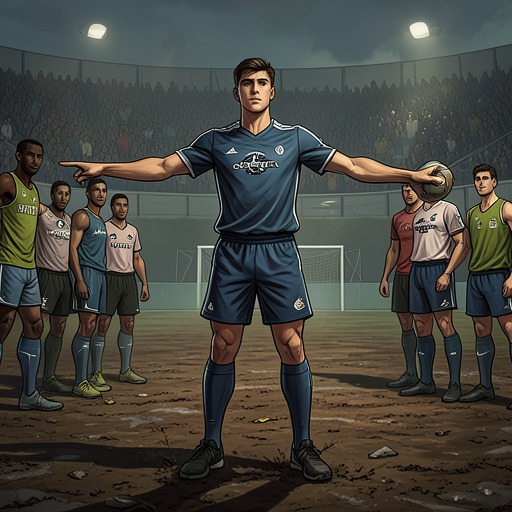
The ball’s return does not restore Kevin’s old individualism. In the decisive match, the Wild Soccer Bunch begins with a coordinated sequence: Kevin starts the attack, passes to Alex Alexander, receives a return through Tyler, and then moves the ball through Danny and Joey before taking his shot. Later, when the score reaches nine to nine, Kevin finally tells Larry that he will pass the ball. The promise comes after he has lost possession by refusing to pass and has been removed from the field for wanting the tenth goal for himself. The ball therefore becomes the measure of Kevin’s change: he must learn that keeping it is not the same as controlling the game.
The match is played in rain and mud, conditions in which the Unbeatables slide while the Wild Soccer Bunch moves confidently because of its twelve days of muddy training. The ball travels through a sequence of shared actions rather than a single star performance. Kevin scores his third goal, Danny scores his second, Joey equalizes at seven to seven, Tyler scores from halfway down the field, and Diego returns to his Tornado form after forgetting his asthma. When the final goal arrives, Roger scores the winning goal after earlier hesitation and missed chances. The team then carries Roger on its shoulders while Kevin lies in front of the goal, stunned that Roger the Hero has become their hero.
Material and Thematic Significance
The ball repeatedly shifts between transparency and obstruction. At first it is an ordinary tool for play, so essential that Kevin and Tyler risk punishment by using it indoors. Once adults confiscate it, once it is hidden in the hamster cage, and once the possibility of its destruction by Sox becomes immediate, its material presence becomes impossible to ignore. It is locked, carried, endangered, withheld, and recovered. Each disruption reveals how much the children’s freedom depends on a fragile object and on adult control over access to it.
Its history also crosses the team’s social differences. Joey cannot afford cleats, lacks a jacket, sometimes misses practice, and lives in a van with his unemployed mother, while Kyle is rich. Kevin’s ball does not erase those inequalities, but on the field it provides a common medium through which Joey can play like a magician and participate fully in the team’s success. Larry, who works at the lemonade stand and never became a professional player, controls the ball during training and proves that its value lies not in private ownership but in the knowledge of how it is used.
By the end, Kevin’s soccer ball has traveled from his lap, bedroom, hamster cage, and father’s locked office to the muddy field where the Wild Soccer Bunch wins. Its decisive significance is not that it enables Kevin to score, but that it survives the conflicts that make private possession untenable. The ball remains Kevin’s in name, yet its fullest meaning appears when it passes among Alex Alexander, Tyler, Danny, Joey, Roger, and the rest of the team. It becomes the physical sign of a community formed by discipline, sacrifice, and trust: the object Kevin once defended as exclusively his is finally the means by which the team wins together.